Aspen (Populus tremula) is a rare but distinctive tree in Scotland’s native woodlands, particularly in the Caledonian Forest remnants and northern regions. Its leaves shimmer and tremble in the breeze, bringing movement and light to the woodland canopy. In autumn the foliage can turn striking shades of yellow, orange and red.
The species can grow at elevations of up to around 550 metres and tolerates a wide range of soils and conditions. However, its present distribution is largely the result of historical deforestation and long-term grazing pressure; it is now mostly found on steeper ground out of reach of deer and livestock and in places that are out of the way.
Aspen supports a rich variety of wildlife, including many insects, rare moths, the aspen hoverfly, and numerous lichens and fungi. Old trees and deadwood also provide valuable habitat for bats and other species.
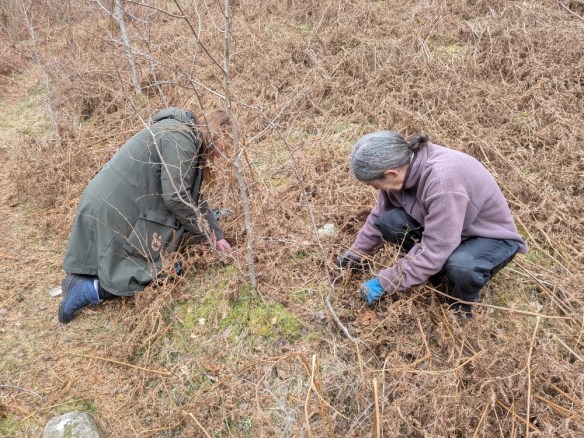
On 23rd March 2026 TWP members visited two sites to collect root cuttings for propagation:
Foss Road above the Linn of Tummel (NN 90543 60126)
The road beyond Bruar (NN 81000 65733)
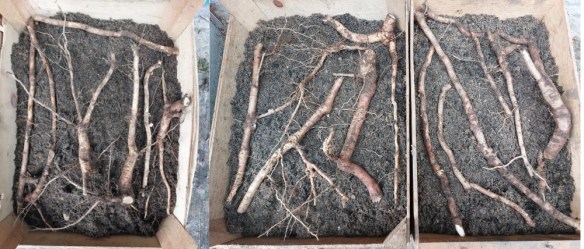
The shallow roots between parent trees and saplings made collection relatively straightforward. When returned to the nursery cuttings were planted in shallow wooden trays using a 50:50 mix of peat-free multipurpose compost and sharp sand. The trays have been placed in a semi-shaded corner, and we hope to see signs of rooting and growth during the course of this year.
Aspen is a clonal organism. All the trees (ramets) in a stand are genetically identical and form one individual that is either entirely male or entirely female. Because Scottish aspen populations are now highly fragmented, male and female clones are often too far apart for effective pollination (also see vicariance). Flowering and viable seed production are therefore rare in Scotland. The reasons are not fully understood, but our cooler, oceanic climate and the great age of many existing clones (which can live for hundreds or even thousands of years) are thought to play a part. As a result, natural regeneration from seed is very limited.
Where possible, conservation planting should use seed-grown aspen rather than purely clonal material. Seed-grown trees introduce new genetic combinations and help restore the potential for future genetically diversified reproduction ans species genetic resiliance. Our current collection of root cuttings from local sites around Pitlochry is deliberately focused on increasing very local genetic diversity. In time, we hope the Pitlochry area can become a more reliable source of viable aspen seed. Further information on aspen can be found on the Trees for Life website.
Through this work we aim to increase the presence of this locally scarce native species in suitable sites across Tayside and contribute to more diverse and resilient woodlands.
Get Involved Interested in helping with our propagation projects or future planting days? Please contact us.
 Tayside Woodland Partnerships
You must be logged in to post a comment.