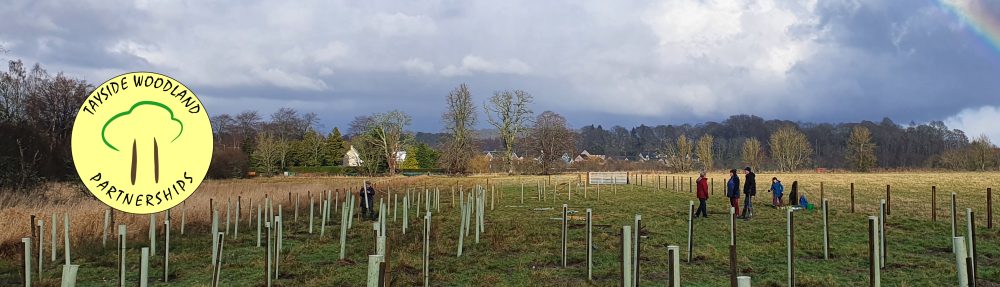
Farmers and other landowners in Tayside wishing to offset some of their emissions from livestock or machinery, can contact the Tayside Woodland Partnership to establish new woodlands, sharing the costs and benefits.
The Tayside Woodland Partnership (TWP) mobilises community members around Tayside to establish new woodlands offsetting CO2 emissions. The group aims to work partnership with local farmers and landowners sharing any carbon credits that may accrue in the future. The community will provide the trees and voluntary labour for creating and maintaining the woodland, offsetting costs not covered by the Forest Grant Scheme.
Alastair Fraser, co-founder of the Group says “woodlands bring many benefits to farmers as well as to local communities and wildlife through their impact on the local micro-climate and environment””
Johnny Agnew of Blackhaugh Farm near Spittalfield has already agreed to participate with the Group and has offered some land that is part of a field normally grazed with sheep.“We have part of a sheep grazing field that has always been a problem. Its low lying, and slightly wetter than the rest of the field so it has a high density of rushes. This substantially reduces the productivity of the grazing. The site is excellent for tree growth but frankly organising the fencing, tree ordering and planting was going to be too time consuming for us”
The site will be fenced and planted in November this year with a mixture of native broadleaved trees. Native broadleaved species will be planted, including oaks, birch, rowan, field maple and wild cherry, with willow and alder in the wettest spots.
Some sites, especially in the uplands and those that are infested with bracken will lend themselves to conifers of which Scots pine and juniper are the only truly native species, so the species that the group will plant will depend on the wishes of the landowner and the local site conditions. European species such as Norway spruce, European silver fir and European larch could be considered for some mites..
Depending on the area to be planted the woodland can be registered with the Woodland Carbon Code operated by Scottish Forestry and the woodlands will be evaluated periodically to assess how much carbon they captured. The woodland will then qualify for Woodland Carbon Units that can be sold or held as evidence of the quantity of emissions that have been offset. The current value at auction of a WCU is about £20 for a tonne of CO2e, but this is expected to rise substantially in the future as governments introduce measures for carbon pricing that reflect the true economic cost of the emissions. The EU for example, is currently considering a border tax on the carbon footprint of imports which would make the export of meat to Europe more expensive and reduce profits for the exporter. The WCU certificate could be used to offset part or all of the carbon footprint from livestock and hence avoid such a tax.
 Tayside Woodland Partnerships